Spirituality · First issue · Opening letter
Fix your eyes on Christ: why is Logos born?
This newspaper begins with two handwritten pages: on the left, a message received one night; on the right, the next morning’s prayer, which is the first step. Today the first issue is published.
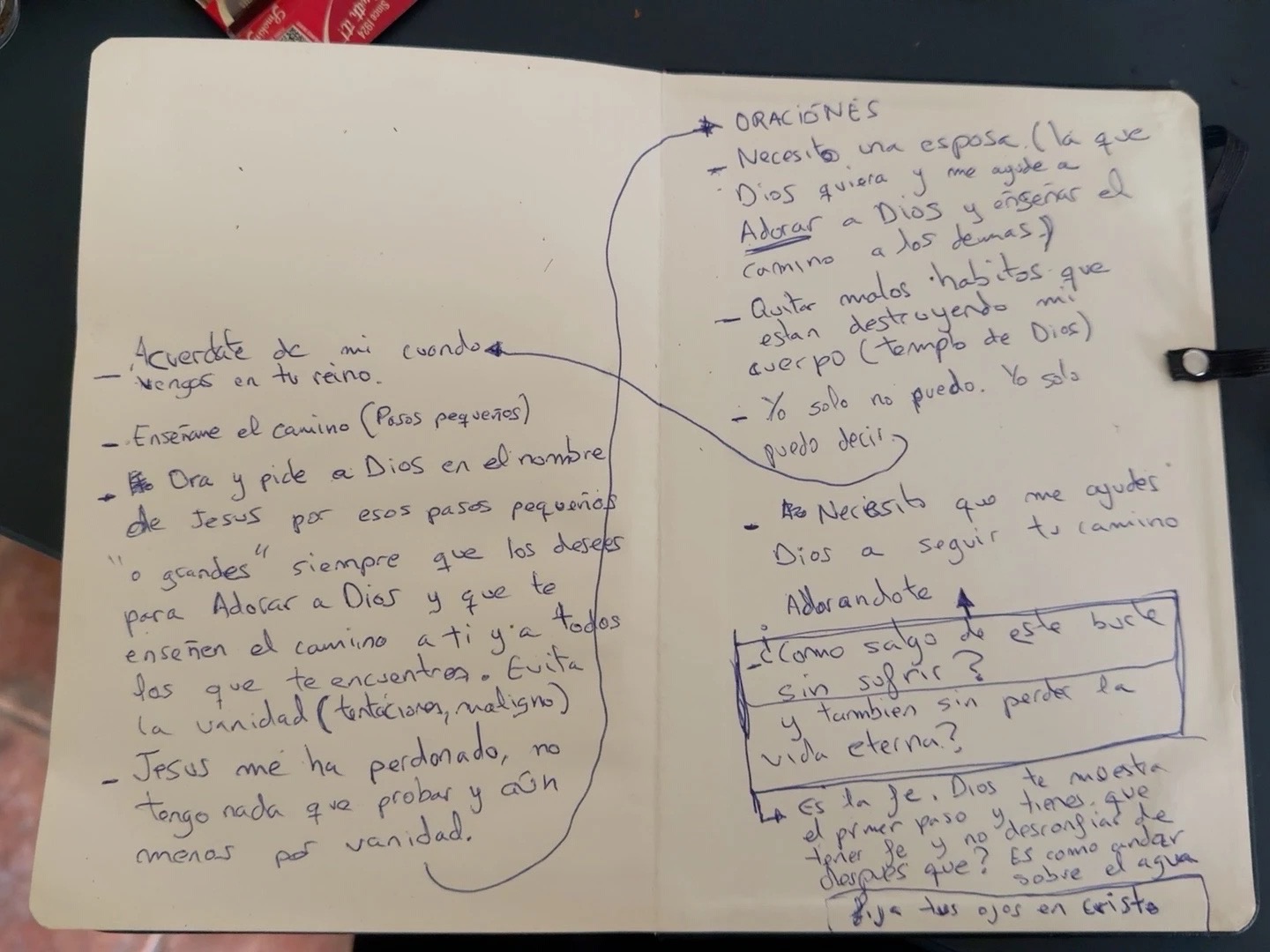
This newspaper is born from a notebook open at two pages. They are not a reporter’s notes. On the left-hand page there is a message; on the right, a prayer. Between them, an arrow joins the two. What follows is the story of those two pages, because everything else comes from them.
The left-hand page: the message
It was written at night by the person who received it, in the handwriting of someone jotting things down fast so as not to lose any of it. It begins with a plea borrowed from the good thief: “Remember me when you come into your kingdom.” It goes on with a request: “Teach me the way,” and a parenthesis that changes everything: “small steps.” Then an instruction: to pray and ask God, in the name of Jesus, for those steps, small or large, “as long as the desires are to worship God and to teach the way to those you meet.” And an underlined warning: avoid vanity, which is a temptation and comes from the evil one. It ends with the freest sentence on the two pages: “Jesus has forgiven me. I have nothing to prove, least of all out of vanity.”
The right-hand page: the prayer
The next morning, the same hand did what the message said: pray and ask. With an underlined heading, “Prayers,” and no embellishment. It asks for a wife, “the one God wants,” and that she help him worship God and teach the way to others. It asks to be rid of the bad habits that are destroying his body, because the body is a temple of God. And it admits what almost no one writes down: “I can’t do it on my own; all I can do is say: Remember me when you come into your kingdom.”
Further down there is a box with a question inside it: “How do I get out of this loop? Without suffering? And without losing eternal life, too?” The loop is this: you want to be rid of your bad habits and failings; God forgives you; you fail again; God forgives you again. And so on. Anyone who has tried to change something about themselves knows it, and knows the trap too: believing you get out of it by pushing harder, vowing to do better, doing the same thing with more force. That is not how you get out. You get out when you stop pretending you can and tell the truth: “I can’t do it on my own; I’m stuck in this loop, and the only thing left for me to say is: remember me when you come into your kingdom.” That sentence is not a surrender. It is the first step. The box says so a little further down: “That is faith. God shows you the first step, and not to doubt. And what comes after? It’s like walking on water: fix your eyes on Christ.”
The first step
Peter climbed out of the boat because Jesus asked him to, and he walked as long as he kept his eyes on him; he sank when he looked at the waves. The two pages of the notebook tell the same story in order: first the message arrives, then it is obeyed. The prayer on the right is not a commentary on the message on the left: it is the first step the message asked for, taken the next morning from inside the loop, without yet knowing what the second will be. That is faith in small steps.
We turn it into an editorial rule. The prayer was the first step. This newspaper is only one step more.
Sample edition: the texts are provisional and will be replaced with real content.